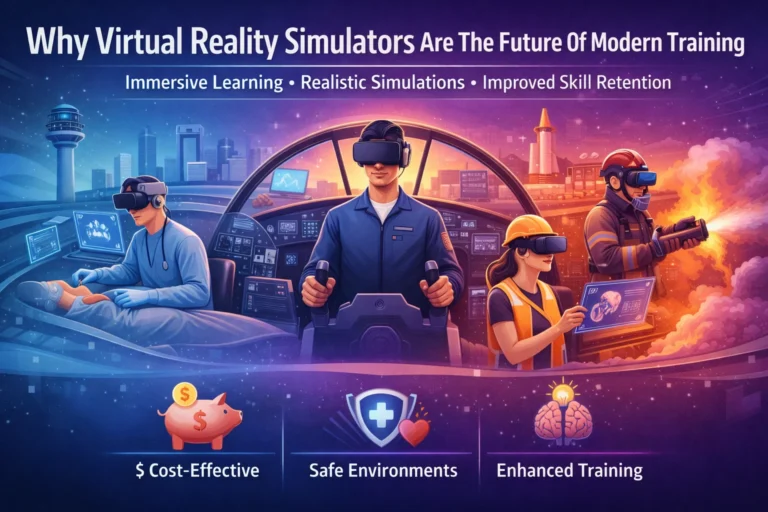
Technology for virtual reality simulators will change how people learn, practice, and master difficult skills. VR simulation allows people to train in an immersive environment that simulates the real world, giving them a chance to build skills rapidly while minimizing training hazards. VR simulation has applications across many industries, including aviation, health care, engineering, and military. VR-based learning creates immersive, hands-on simulations that provide a unique experience that traditional learning techniques cannot replicate; therefore, as businesses search for better and more affordable ways to provide immersive/immersive training, the future of VR-based training looks promising, scalable, and future-ready learning approach.
Key Benefits of VR-Based Learning and Simulation Training VR
- Accelerated Skill Mastery: VR based learning helps learners practice repeatedly in realistic environments without physical limitations.
- Reduced Training Risks: Simulation training VR safely replicates hazardous or high-pressure scenarios for safe practice.
- Cost-Effective Training: Eliminates the need for physical equipment, travel, and resource-heavy setups.
- Higher Retention Rates: Immersive visuals and interactive tasks enhance memory and long-term knowledge retention.
- Real-Time Feedback: Trainees receive instant, data-driven insights to improve performance.
VR based learning and simulation training provide unmatched flexibility, safety, and cost savings for organizations. These solutions enable trainees to learn at their own pace, repeat tasks until they are mastered, and receive immediate feedback. This leads to consistent performance improvement and stronger overall competency.
1. Immersive Learning Environments
VR simulators create highly immersive, distraction-free learning environments where using virtual reality (VR) technology allows students to learn through highly immersive, distraction-free environments where they can interact with their surroundings or other characters as they would in real life. The ‘high-level’ of engagement that VR provides allows students to develop ‘stronger’ cognitive connections (s) between events, actions and skills, thus enhancing their understanding and ability to apply these skills appropriately.
2. Effective Skill Training for High-Risk Jobs
Certain professions require a high level of precision and safety, such as firefighting, medical surgery, aviation, and military operations. With the use of VR (virtual reality) simulations, trainees can experience many iterations of their respective jobs with no danger to themselves or others and get prepared for the high-pressure environment in which they will operate by getting as close to that experience as possible through the use of VR.
3. Personalized and Adaptive Learning Paths
Through the assessment of user performance, virtual reality training systems modify the challenges faced by an individual to enable each individual to have a customised learning experience. This helps each user advance through the course at a pace suited to them specifically, thus allowing for the smooth bridging of skill deficits while allowing for greater focus on the areas needing improvement through further training and reinforcement.
4. Real-Time Performance Tracking and Analytics
The virtual reality simulator gathers numerous performance indicators such as accuracy, reaction times, decision-making ability, and overall success rate on tasks completed. The Instructor can utilize these analytics to evaluate the performance of all driven trainees, identify areas needing improvement, and improve the overall effectiveness and efficiency of the training.
Frequently Asked Questions

CEO & MD
The CEO and Managing Director at Vizent Solutions, Bigyan Kar, leads a team of talented technology professionals who excel in the development and implementation of next-generation 3D visualization solutions for the following areas: gaming, architecture, AR/VR, CAD, and interactive simulations. Through his knowledge of digital design and technology, as well as his commitment to providing the highest level of immersive, accurate, and reliable 3D experiences for its clients, Vizent is constantly innovating and pushing the boundaries of the 3D modeling and visual storytelling industries.