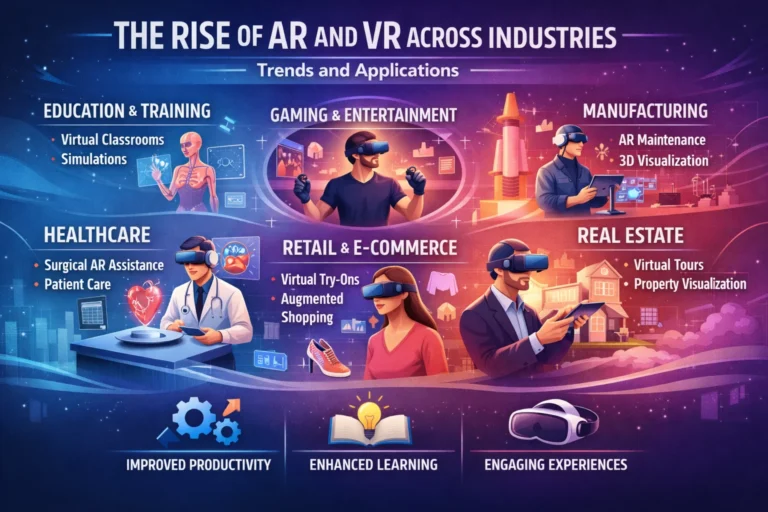
Augmented reality (AR) and virtual reality (VR) technologies are reshaping the means of business, innovation, and customer interactions. A wide range of uses, including enterprise training, healthcare simulations, and immersive retail experiences, have contributed to the rapid adoption of AR and VR as a formidable weapon in the fight for digital transformation. Companies are using these technologies to cut expenses, raise their output levels, and enhance the experience of their users. We will review current trends in AR and VR trends, industries using these technologies, and examples of the revolutionary power of these technologies in this article.
Key AR VR Applications Shaping the Future of Digital Innovation
| AR/VR Application Area | Description | Industry Impact |
| AR in Business Operations | Enhances workflows with real-time data overlays | Improved accuracy and efficiency |
| VR in Training & Simulation | Creates immersive learning modules | Safer, cost-effective training |
| AR/VR in Customer Experience | Engages customers through interactive 3D experiences | Higher conversions, retention |
The use of AR VR applications is rapidly increasing as more industries use immersive technologies to improve efficiency, lower training costs, and enhance customer experiences. With the growing acceptance of both AR and VR, many organizations are using these allied technologies to create richer, more efficient, and more engaging digital experiences.
Widespread Adoption of AR in Business Settings
Augmented reality in the business is fast becoming a common practice for improving accuracy, facilitating remote assistance, and visualizing complex workflows. Industries, like manufacturing, logistics, retail, and real estate, are leveraging augmented reality to communicate data-rich overlays, eliminate mistakes, and improve speed and reliability in decision-making.
Global Growth of the Virtual Reality Industry
The rate of growth in the virtual reality industry is increasing at a rapid pace, driven primarily by increased spending for training, entertainment, and enterprise solutions using immersive techniques. The price and capabilities of VR technology continue to increase, making VR experience more appealing for organizations to use for onboarding, product development, remote collaboration, and large-scale industrial simulation.
AR VR Technology Adoption in Training and Education
The use of AR VR technology in training and learning environments is radically changing the way individuals develop skills. Immersive classrooms, virtual laboratories, and realistic simulations provide opportunities for students and professionals to have a safer environment to learn, where mistakes in the real world are not an issue, leading learners towards increased systems knowledge retention and hands-on competency.
AR VR Applications in Retail, Healthcare, and Real Estate
Retail brands use AR try-ons, healthcare uses VR for surgical planning, and real estate relies on virtual property walkthroughs. These AR VR applications deliver personalized, immersive, and highly interactive experiences that help professionals work efficiently and enable customers to make informed decisions more quickly.
Major Industry Trends Accelerating AR and VR Adoption
- Cross-industry collaboration to standardize AR and VR ecosystems
- Increased investment in lightweight AR glasses and wireless VR headsets
- Rapid improvements in 5G, spatial computing, and real-time rendering
AR and VR adoption is growing as technological capabilities improve, making immersive tools faster, lighter, and more intuitive. With enterprises investing heavily in AR glasses, spatial computing, and cloud-based rendering, these advancements are accelerating deployment across industries from engineering to entertainment.
Rise of Enterprise AR for Operations and Maintenance
Enterprise AR is streamlining maintenance, repair, and quality checks. Field workers use AR headsets to receive real-time instructions, reducing downtime and eliminating errors. This trend is particularly strong in manufacturing, automotive, and aviation sectors, where precision and safety are crucial.
Immersive VR for Workforce Upskilling
VR-based training is becoming essential for industries with high-risk environments such as mining, oil and gas, construction, and healthcare. Immersive simulations help employees practice complex tasks safely, while organizations save costs otherwise spent on equipment, travel, and traditional training setups.
AR VR in Consumer Experiences and Smart Retail
Consumer brands are adopting AR try-on apps, VR stores, and virtual showrooms to offer personalized shopping experiences. This trend is boosting customer engagement and improving online shopping conversions, bridging the gap between physical and digital retail environments.
Growth of Metaverse and Spatial Computing Platforms
The metaverse and spatial computing are accelerating AR and VR integration across entertainment, gaming, and enterprise collaboration. Virtual workplaces, 3D avatars, and shared environments allow teams to collaborate globally, reducing reliance on physical spaces and redefining how digital interaction takes place.
Future Outlook: What’s Next for AR and VR?
- Widespread use of AR glasses for daily productivity
- VR is becoming mainstream for training and simulation
- Stronger integration with AI and real-time analytics
The future of AR and VR points toward deeper integration with AI, enabling intelligent digital overlays and hyper-personalized experiences. With hardware becoming cheaper and more powerful, AR and VR will evolve into everyday tools supporting work, entertainment, education, and decision-making.
Frequently Asked Questions

CEO & MD
The CEO and Managing Director at Vizent Solutions, Bigyan Kar, leads a team of talented technology professionals who excel in the development and implementation of next-generation 3D visualization solutions for the following areas: gaming, architecture, AR/VR, CAD, and interactive simulations. Through his knowledge of digital design and technology, as well as his commitment to providing the highest level of immersive, accurate, and reliable 3D experiences for its clients, Vizent is constantly innovating and pushing the boundaries of the 3D modeling and visual storytelling industries.