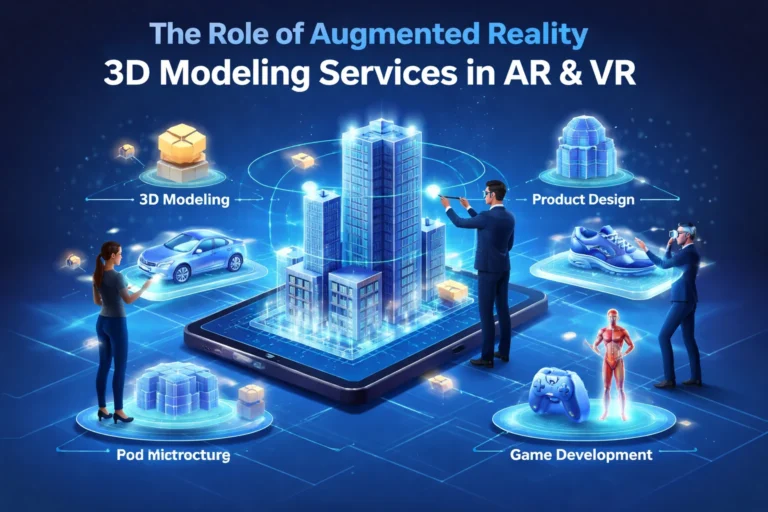
The use of Augmented Reality 3D modeling services is incredibly important for the development of GA (General AR) and VR products in all types of industries because the quality of these products depends on the actual design of an object. Without high-quality, lifelike 3D models, users will not be able to see a real representation of items or objects in their home. When used alongside VR 3D modeling and VR environment modeling, the ability to create lifelike, dynamic, and scalable experiences that connect both “physical” and digital environments will continue to drive the growth of augmented reality and provide endless opportunities.
Understanding Virtual Reality 3D Modeling and Its Core Purpose
Virtual reality 3D modeling focuses on creating detailed digital assets and spaces that users can explore in a fully immersive environment. These models are optimized for real-time interaction, ensuring smooth navigation, realistic lighting, and accurate scale within VR platforms.
Key Components of Virtual Reality 3D Modeling
Virtual reality 3D modeling involves geometry creation, texture mapping, lighting optimization, and animation. Each component ensures that the virtual space feels realistic, performs efficiently, and responds naturally to user interactions within VR headsets and devices.
Why VR Environment Modeling Is Essential for Immersive Experiences
VR environment modeling transforms individual 3D assets into complete, navigable worlds. It focuses on spatial design, scale accuracy, and environmental storytelling, ensuring users feel fully present within the virtual experience rather than simply observing it.
Designing Realistic and Interactive VR Environments
Effective VR environment modeling blends architectural accuracy, realistic textures, and interactive elements. This combination allows users to move freely, interact with objects, and experience environments that closely replicate real-world or imagined spaces.
How Augmented Reality 3D Modeling Services Enhance Real-World Interaction
Augmented reality 3D modeling services overlay digital 3D objects onto real-world settings. These models must be lightweight, accurate, and responsive, enabling seamless integration with physical environments through mobile devices, tablets, or AR headsets.
Optimizing 3D Models for Real-Time AR Applications
AR-ready models require optimized polygon counts, efficient textures, and precise scaling. Proper optimization ensures fast loading, smooth performance, and accurate placement of digital objects within real-world environments.
Industries Taking Advantage of 3D Virtual Reality Modeling
Virtual reality (VR) modeling is growing in popularity and application throughout the gaming, real estate, healthcare, education, and manufacturing industries. By providing an immersive experience, each of these industries can benefit from the various aspects of VR, including training, visualization, decision making, and customer engagement.
3D Modeling for Virtual Reality Uses by Industry
VR provides a way to create an immersive environment for real estate agents, healthcare professionals, industrial workers, and gamers. These uses of virtual reality 3D modeling offer safe, economical, and engaging experiences tailored to the needs of each individual industry. Virtual property tours, medical simulations, industrial training simulations, and gaming environments are just a few examples of how VR is helping companies benefit from the capabilities offered by this technology.
The Technical Process for Creating 3D Models for AR and VR
The technical process of modeling AR and VR includes a workflow starting with concept and 3D Model Creation, then optimization, and Testing. The end product of each stage is to ensure that it is functional in both AR and VR environments, while maintaining the level of performance and quality of visual content for both systems.
Taking a Project from Concept to Deployment Using AR and VR Technology
Understanding the goals of the project will be the first step in the process. After this, the company will need to develop and optimise a 3D modelised representation of the proposed site using VR software before integrating it into either AR or VR Platforms, thus allowing the models to function seamlessly across different devices and providing the same experience to users.
Key Benefits of 3D Modeling in AR & VR
- Enhances realism and immersion in digital experiences
- Improves user interaction and engagement
- Enables accurate visualization before real-world implementation
AR vs VR 3D Modeling
| Aspect | Augmented Reality 3D Modeling | Virtual Reality 3D Modeling |
| Environment | Real-world + digital overlay | Fully digital environment |
| Model Complexity | Lightweight and optimized | Highly detailed and immersive |
| User Experience | Interactive enhancement | Complete immersion |
Future Trends in Augmented Reality and Virtual Reality 3D Modeling
Advancements in real-time rendering, AI-driven modeling, and hardware capabilities are shaping the future of AR and VR. These innovations will make augmented reality 3D modeling services and VR environment modeling more accessible and realistic.
How Emerging Technologies Are Transforming 3D Modeling
Technologies like AI-assisted modeling, real-time ray tracing, and cloud-based workflows are reducing production time while enhancing realism. These trends are redefining how AR and VR experiences are designed and delivered.
Frequently Asked Questions

CEO & MD
The CEO and Managing Director at Vizent Solutions, Bigyan Kar, leads a team of talented technology professionals who excel in the development and implementation of next-generation 3D visualization solutions for the following areas: gaming, architecture, AR/VR, CAD, and interactive simulations. Through his knowledge of digital design and technology, as well as his commitment to providing the highest level of immersive, accurate, and reliable 3D experiences for its clients, Vizent is constantly innovating and pushing the boundaries of the 3D modeling and visual storytelling industries.